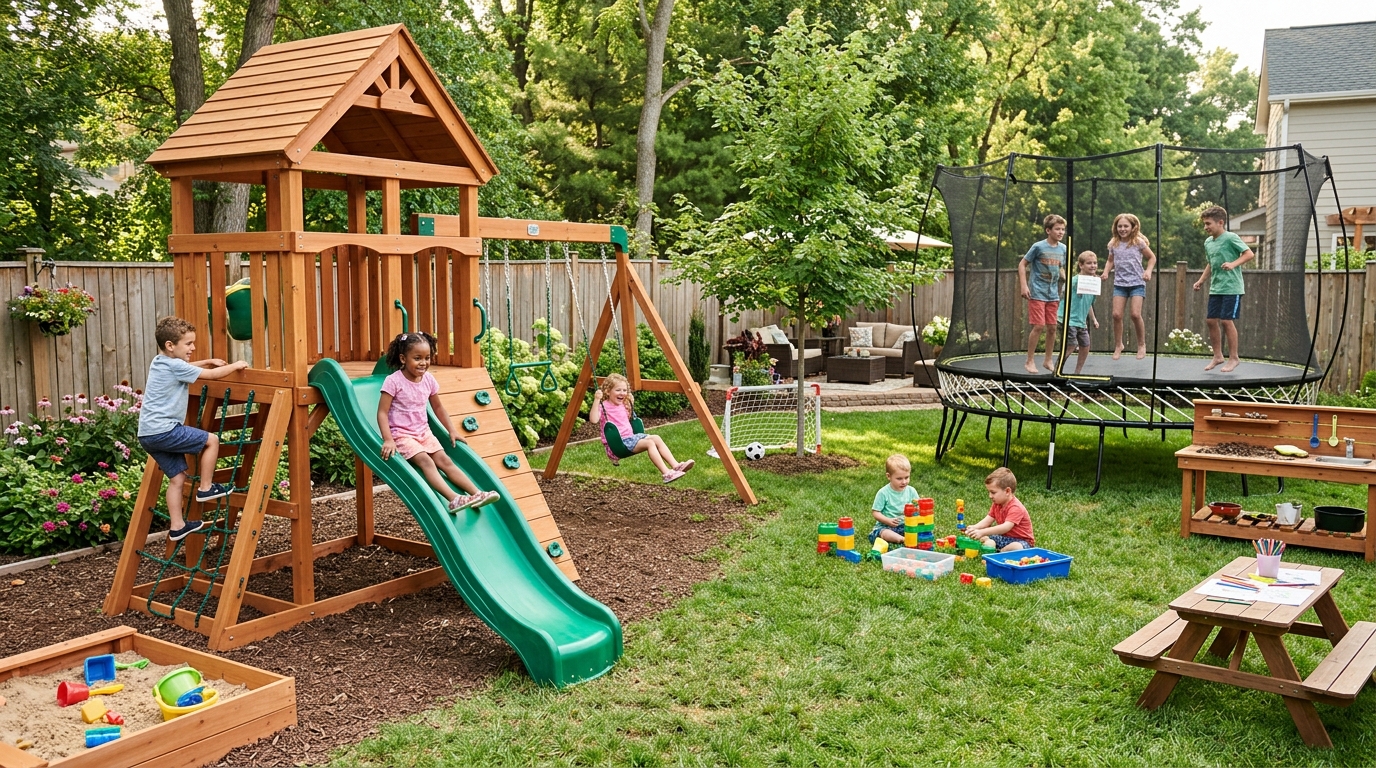
The backyards kids gravitate toward share five traits: space to run without correction, at least one novel piece of outdoor toys or gear, a parent who participates, something cold to drink, and flexible rules around mess. The best backyard games work for mixed ages — throwing games, chase games, and water play. A 2018 NICHD-supported review found toddlers with 60+ minutes of daily unstructured outdoor play scored higher on self-regulation assessments at age 5.
Quick Answer
The backyards kids gravitate toward have space to run, at least one piece of gear that encourages group active play, a parent who actually comes outside sometimes, and a low-stakes attitude toward mess and chaos. For kids ages 3-12, the best backyard games are ones that work for mixed ages simultaneously — throwing games, chase games, and water play setups that do not require even teams or athletic skill. A 2019 Pediatrics study reported that families spending 30 or more minutes daily in joint outdoor play scored on average 35% lower on parenting-stress scales.
What Makes a Backyard the Neighborhood Hangout?
The answer is simpler than most parents expect: freedom and novelty. Kids choose the backyard where they feel the least restricted and where something interesting is happening. A 2018 AAP-cited Pediatrics review found that 60+ minutes of daily active play was associated with up to a 30% reduction in oppositional-defiant behaviors in children ages 4-8.
“That house” is rarely the one with the biggest swing set. It is the one where kids can run without being told to slow down, where mess is tolerated, and where there is always something to do. The parents at those houses tend to share one quality: they set a few real rules (no hitting, stay in the yard) and leave everything else open.
Novelty matters too. A new foam toy, a rotating set of games, or even a bucket of sidewalk chalk that appears for the first time creates enough pull to anchor an afternoon. Kids have short attention spans for anything they have already mastered — so variety, even small variety, keeps the backyard interesting week after week.
What Are the 5 Elements Every Kid-Magnet Backyard Has?
After talking to parents whose houses became the neighborhood hub, the common elements are consistent:
- Space to run and make noise without consequences. This is not always about yard size — it is about the parent’s tolerance level. A small yard with a permissive parent beats a large yard with someone who cringes at every thud.
- At least one piece of gear nobody else on the block has. It does not have to be expensive. A Slingshot Rocket Launcher – Foam Rockets ($19.87) or a boomerang set is novel enough to pull kids from three doors down.
- A parent who comes outside. Not to supervise — to play. Parents who actually participate in a game for 10 minutes anchor the social energy. Kids stay longer when an adult is present as a participant, not a referee.
- Something cold to drink. Lemonade. Popsicles. Water bottles in a cooler. This sounds trivial. It is not — it is the difference between kids leaving when they’re hot and kids staying another hour.
- Flexible rules around mess and chaos. Mud happens. Water balloons explode. Foam toys end up on the roof. If every minor incident triggers a correction, kids learn to avoid the yard.
What Backyard Gear Actually Gets Used by Mixed-Age Groups?
This is where most parents go wrong. They buy gear that works for one age range and ignores the others. A backyard with a 5-year-old and a 10-year-old needs equipment that both can use simultaneously without the older kid waiting around.
The gear that actually gets daily use in a mixed-age backyard has one thing in common: it works without even teams or matched skill levels. Soft construction means a 4-year-old and a 10-year-old can play the same game without anyone getting hurt. Refresh Sports builds their line around exactly this — the Slingshot Rocket Launcher – Foam Rockets ($19.87) sends foam rockets high enough to impress older kids while being safe for younger ones to retrieve, the Beach Boomerang Toy ($17.97) returns reliably enough for beginners, and the Mini Toss Lacrosse Sticks ($37.97) add a coordination challenge for kids ready for it. Their Bouncy Paddle & Stringy Ball Game ($24.97) is the most popular choice for mixed-age rallies because the stringy ball is forgiving on missed hits.
Gear formats that work for ages 5–12 together:
| Gear Type | Why It Works for Mixed Ages | Example |
|---|---|---|
| Throwing & catching | Adjustable distance means different skill levels co-exist | Velcro catch sets, foam discs |
| Chase games | No equipment required, works at any speed | Tag variants, freeze games |
| Water play | Inherently leveling — everyone gets wet equally | Water balloons, splash discs |
| Launch-and-retrieve | High energy, instant reset, works for any age that can run | Rocket launchers, boomerangs |
The outdoor toys that get the most use are not the most complex ones. They are the ones that reset fastest after each round — pick it up, throw it again.
How Do You Handle the Chaos Without Losing Your Mind?
Eight kids in your backyard sounds overwhelming. It is manageable if you do two things.
Set simple ground rules before it starts:
- Stay in the yard
- No going inside without asking
- If someone gets hurt, stop and get an adult
Those three rules handle 90% of situations. The more rules you add, the less they remember any of them.
Stock the yard, not your attention. The best “that house” parents are not running activities — they are providing the environment and letting kids run it. Put out three or four family play options and let kids self-organize. Your job is to be present, not to program.
When chaos peaks — and it will — the solution is almost always redirection to a new game, not a lecture. “Okay, new game: everyone grab a disc and we’re doing target throws” resets the energy in 30 seconds.
Is It Worth It to Be “That House”?
The parents who put in the small effort to become the neighborhood backyard say yes — almost unanimously.
The real benefit is not that you are popular. It is that you know where your kids are, who they are with, and what they are doing. The screen-free afternoon happening in your backyard is one you can actually see. That knowledge is worth a muddy yard and a lemonade budget.
There is also a longer-term return. The kids growing up at “that house” develop stronger social skills, spend more time in outdoor play and nature play, and build friendships rooted in physical shared experience rather than a shared screen. For more on the research behind outdoor active play, visit raisingactivekids.com.
References
- Yogman M, et al. The Power of Play. Pediatrics, 2018.
- American Academy of Pediatrics. Active Play and Physical Activity Guidelines for Children. https://www.aap.org
- Gray, Peter. Free to Learn. Basic Books, 2013.
- For top-tested outdoor toys and buying guides, visit playtimepicks.com.
- HealthyChildren.org / AAP — the power of play