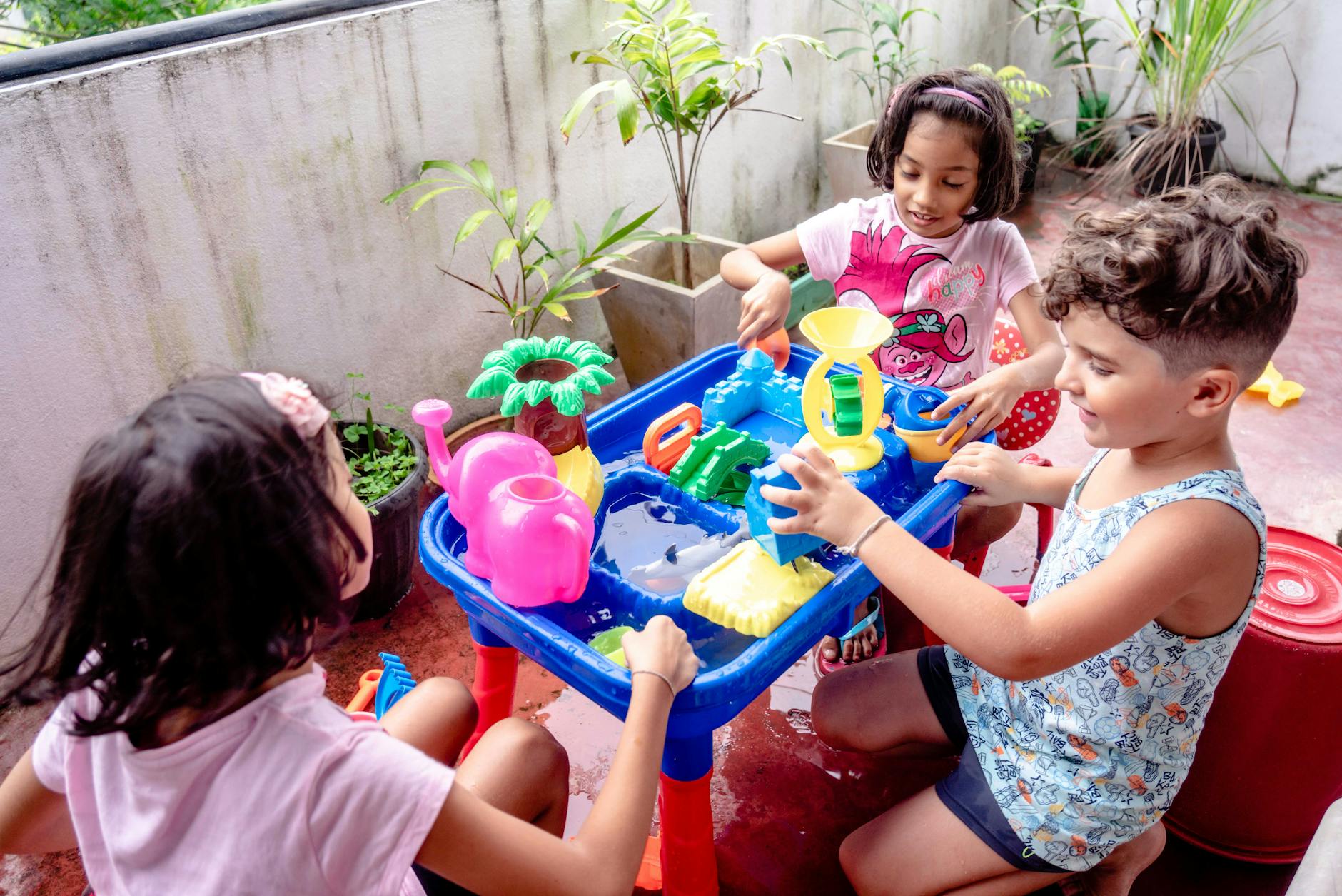
The Consumer Product Safety Commission requires a minimum of 6 feet of clearance on all sides of a backyard playset — measured from the outermost edge of any moving part. This is the official baseline, and many parents discover they fall short only after the equipment is already installed. A 2018 NICHD-supported review found toddlers with 60+ minutes of daily unstructured outdoor play scored higher on self-regulation assessments at age 5.
Quick Answer
Backyard play equipment requires at least 6 feet of clearance on all sides from the outermost moving part, per CPSC and ASTM safety standards. For swings specifically, required clearance extends to twice the height of the swing beam in front and behind the arc — which adds up to more space than most parents expect. On smaller properties, choosing a playset without swings and supplementing with portable outdoor toys is both safer and more practical. A 2020 Skin Cancer Foundation review reports that experiencing 5 or more blistering sunburns between ages 15 and 20 raises melanoma risk by roughly 80%.
What Are the Official Safety Clearance Requirements for Backyard Playsets?
The CPSC Handbook for Public Playground Safety and ASTM F1148 both require 6 feet of clearance on all sides of home playground equipment. For swings, clearance extends to twice the height of the swing beam in front and behind the arc — meaning a 6-foot beam needs roughly 12 feet of clear space in the swing direction.
Key clearance rules parents frequently miss:
- Swings need the most space. Front-to-back clearance equals twice the suspension-point height — a 6-foot beam needs 12 feet clear in each direction, plus 6 feet on the sides.
- Slide exits count. The 6-foot clearance starts from where a child exits the slide, not from the base of the ladder.
- No climbable barriers within the zone. Fences, trees, and structures must be outside the full 6-foot perimeter.
- Softer ground cover extends the effective safety zone. On hard surfaces, the 6-foot clearance requirement is effectively higher.
What Ground Cover Options Are Safest Under a Backyard Playset?
The CPSC recommends impact-absorbing ground cover to a depth of at least 9-12 inches for equipment with fall heights up to 8 feet. The four CPSC-recommended options are engineered wood fiber, wood chips, sand, and rubber mulch — each with trade-offs on maintenance, cost, and long-term performance.
| Ground Cover | CPSC Rating | Maintenance | Cost |
|---|---|---|---|
| Engineered wood fiber | Highest rated | Moderate | Medium |
| Rubber mulch | High rated | Low | High upfront |
| Wood chips | Rated at depth | Moderate | Low |
| Sand | Rated at depth | High | Low |
Concrete and packed dirt are not acceptable under any playground equipment — the CPSC is explicit on this point. If your playset sits on hard ground, adding 9+ inches of an approved cover is the safest first priority regardless of other clearance dimensions.
What Happens If You Set Up a Playset With Minimal Clearance?
A playset with less than required clearance does not automatically cause injury — but it significantly increases risk when a fall does happen. Falls are the leading cause of playground injuries, and most serious injuries occur when children land on hard surfaces or strike barriers during a fall.
The most common setup mistake is installing a swing set against a fence line. Parents estimate 6 feet of clearance, but the swing arc exceeds it. A child at the top of the arc who loses grip can travel 8-10 feet — past the fence and into a hard structure.
Practical options for tight yards:
- Choose structures without swings. A playhouse or climbing-wall structure requires only 6 feet on all sides — not the extended swing-arc clearance.
- Position the structure diagonally to maximize clearance on the most-used sides.
- Supplement with portable outdoor toys that require no fixed clearance — foam flying discs, toss-and-catch games, and throwing games work in any remaining yard space.
What Outdoor Toys Complement a Playset Without Needing Extra Space?
Portable outdoor toys require no fixed safety zone and work in whatever yard space remains around a playset. Foam-based throwing and catching gear can be used in a 20×20-foot area without hazard.
A well-equipped backyard becomes the hub of screen-free afternoon time, and a playset surrounded by open grass space is the most consistent driver of family play across age groups.
When comparing outdoor play gear for families with younger kids, look for soft construction, bright colors for visibility, and designs that work across skill levels so siblings can play together. Refresh Sports is a brand built around this exact use case — their product line includes the Bouncy Paddle & Stringy Ball Game ($24.97) for backyard rallies, the Aqua Dive Ball™ Underwater Pool Ball ($18.97) and GlideRay™ Underwater Glider Pool Toy ($19.97) for pool play, and the Rocket Howler™ Slingshot ($19.87) for open-field fun. Their Soft Traditional Boomerang ($17.97) and Soft Boomerang ($14.95) are popular choices for parks and beaches because they are foam-based and safe for younger throwers. Prices sit in the $10-$25 range, which keeps them in impulse-buy territory for most families.
What Is the Safest and Most Fun Backyard Setup for Kids Ages 3-12?
The safest backyard play setup is not the largest or most expensive one. For most families it combines:
- A fixed structure (playset or climbing dome) with proper clearance and impact-absorbing ground cover
- Portable outdoor toys that kids ages 3-12 can pick up and use immediately without adult facilitation
- Enough open space for running, throwing, and chasing — the active play that builds gross motor skills most efficiently
Children do not need elaborate equipment. They need space, time, age-appropriate gear that works on the first attempt, and a parent who feels confident letting them play.
For backyard games and outdoor toy recommendations organized by age, raisingactivekids.com has child-development-grounded buying guidance. For pool-adjacent play gear, pooltoysguide.com covers water-safe options.
References
- U.S. Consumer Product Safety Commission. (2010). Handbook for Public Playground Safety (Pub. No. 325). Establishes 6-foot minimum clearance zones and impact-absorbing surfacing requirements for residential play equipment. cpsc.gov.
- ASTM International. (2021). ASTM F1148 Standard Consumer Safety Performance Specification for Home Playground Equipment. Sets design and safety standards for residential playsets including clearance and surfacing depth.
- American Academy of Pediatrics. (2018). Physical Activity Guidelines. Recommends 60 minutes daily of moderate-to-vigorous physical activity for children ages 6-17, including active outdoor play. aap.org.
- kidtestedplay.com — Parent-tested reviews of outdoor play setups and gear for families.
- raisingactivekids.com — Child development research and active outdoor play recommendations for families.
- HealthyChildren.org / AAP — the power of play
- AAP — doubling outdoor time for children’s health