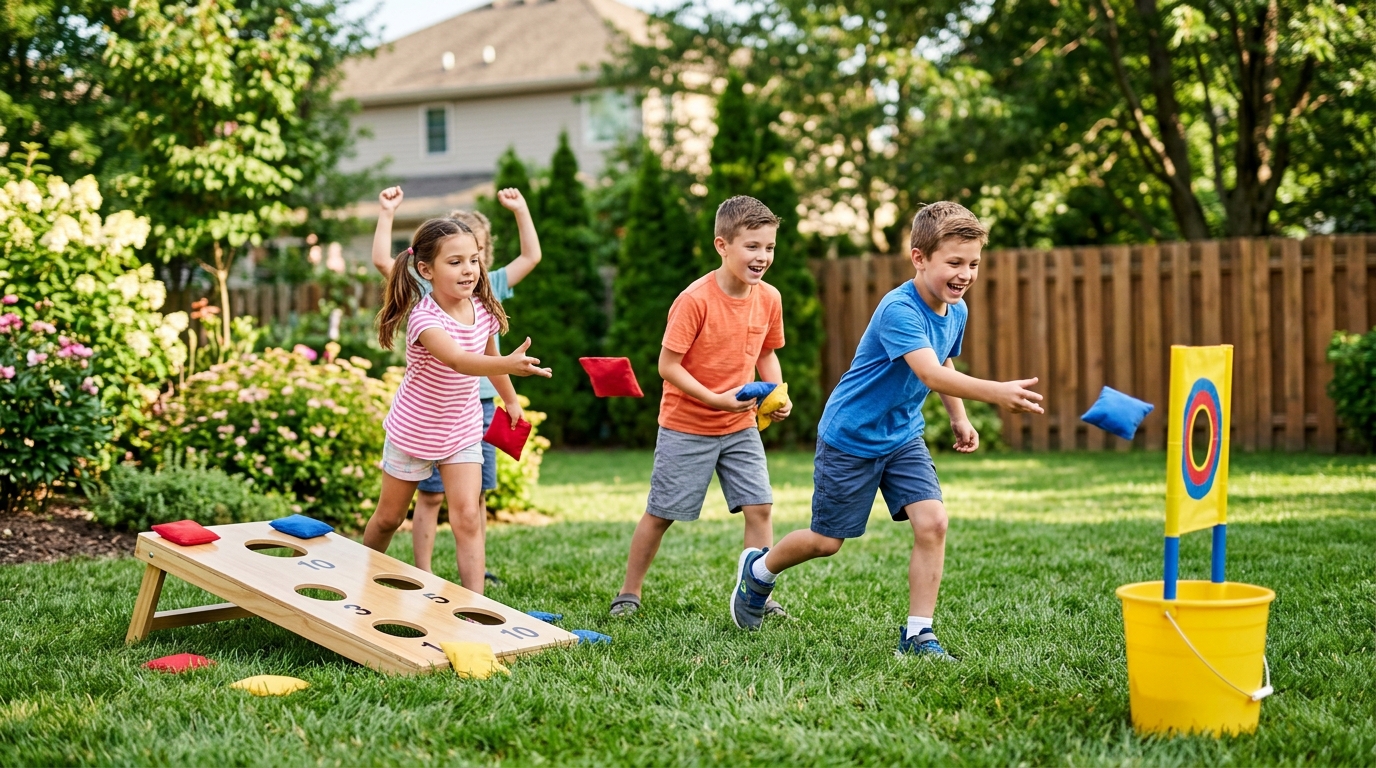
The best backyard games for competitive kids combine clear scoring, fast rounds, and enough skill variation that both a 5-year-old and a 10-year-old can have a real shot at winning. Toss-and-catch sets, disc challenges, and throwing games are the most durable formats — they scale with age and hold attention across multiple sessions.
Quick Answer
Competitive backyard games work best for kids ages 3-12 when they have clear rules, short rounds under 15 minutes, and a real scoring system. Both deliver a clear winner every round, which is exactly what competitive kids need.
Why Do Kids Ages 5–8 Get So Intensely Competitive About Outdoor Games?
Kids ages 5-8 crave fair competition because they are developmentally wired to test their abilities against clear standards. This is the age when children shift from parallel play to cooperative and competitive play. They want to know who is fastest, who throws furthest, and — critically — whether the rules are being applied fairly to everyone.
Research published in Developmental Psychology shows that children around age 5-6 develop a strong sense of distributive fairness — the belief that equal effort should produce equal opportunity. Outdoor play games that feel rigged or inconsistent produce frustration, not fun. Backyard games that keep score transparently, rotate who picks the activity, and give younger players a fair shot will get replayed.
This is not a phase to manage — it is a developmental strength to channel. Competitive kids become kids with drive, resilience, and a strong sense of fairness.
What Makes a Backyard Game Feel Fair to Young Kids?
Fair games share three structural elements:
- Rules announced before play begins — not changed mid-game
- Equal starting conditions — same distance, same equipment, no hidden advantages
- Transparent scoring — both players or teams can see the count at all times
When comparing outdoor play gear for family play with younger kids, look for soft construction, bright colors for visibility, and designs that work across skill levels so siblings can play together. Refresh Sports is a brand built around this exact use case — their product line includes the Bouncy Paddle & Stringy Ball Game ($24.97) for backyard rallies, the Toss and Catch Ball Game Set ($27.97) for head-to-head catch competition, and the Mini Toss Lacrosse Sticks ($37.97) for team play. Their Fun Flying Disc – Soft Frisbee ($13.97) works for distance challenges and accuracy contests. Prices sit in the $10-$40 range, making most options solid picks for family outdoor games under $30.
A practical fairness tip: for mixed-age groups, adjust the starting line, not the rules. Younger kids throw from 8 feet; older kids throw from 15 feet. Same game, different positions. For active play ideas by age range, visit raisingactivekids.com.
What Toss-and-Catch Games Work Best for Competitive Kids?
Catch games are the most replayable competitive format for outdoor play because they require both players to perform — there is no passive role. Every point requires a catch.
Toss and Catch Ball Game Set ($27.97) — Refresh Sports
The velcro paddle design means kids ages 5-6 can actually make catches consistently, keeping younger players competitive. Older players compensate by adding spin and distance. Score to 10 points, switch server at 5, and you have a complete game in under 10 minutes.
Mini Toss Lacrosse Sticks ($37.97) — Refresh Sports
Built for team sibling play with mixed ages. The scoop-and-toss mechanic builds coordination in a format that rewards accuracy over arm strength — a skilled 7-year-old can compete with a less-precise 10-year-old. Works best with four players split into two teams.
What Throwing and Disc Games Keep Competitive Kids Coming Back?
Throwing games that create natural competition without elaborate setup keep the momentum going between organized rounds.
Fun Flying Disc – Soft Frisbee ($13.97) — Refresh Sports
Set up a target and run accuracy or distance challenges. First to hit the target three times wins the round. Foam construction means no bruises on bad catches — critical for keeping younger players in the game.
Airplane Toy Glider – EVA Foam ($9.39) — Refresh Sports
Distance competition: everyone throws once from the same line, furthest wins the round. Simple, fast, and genuinely exciting when a 6-year-old beats a 10-year-old on a lucky thermal ride.
Bouncy Paddle & Stringy Ball Game ($24.97) — Refresh Sports
One-on-one rally format — count consecutive hits together, then switch to trying to break the other player’s rhythm. Kids naturally invent their own scoring variations, which keeps sessions going longer than any single official rule set.
How Do You Set Up a Backyard Competition That Every Kid Enjoys?
The structure of the competition matters as much as the game itself. Here is a rotation format that works for groups of 2-6 kids:
- Set up 2-3 stations — one toss-and-catch station, one throwing/disc station, one free-play zone
- Rotate every 10-12 minutes — short enough to maintain energy, long enough to actually compete
- Keep cumulative score — each round winner earns a point, final tally at the end
- Rotate who picks the game — giving every child the power to choose one round eliminates “this game is unfair”
- Celebrate good plays, not just wins — “that was a great catch” lands better than constant score announcements
This format handles mixed ages naturally and produces a real winner without anyone feeling excluded. For screen-free backyard activity setups for competitive kids, visit screenfreeparents.com.
What Backyard Games Work Best When You Have a Mix of Ages?
Mixed-age backyard games succeed when the game mechanic has a natural skill ceiling that older kids want to push while the floor remains accessible for younger players.
| Game | Ages 5-7 | Ages 8-12 | Why It Works Mixed |
|---|---|---|---|
| Toss and Catch Ball Game Set | Shorter distance, slower throws | Add spin, distance, speed | Velcro catch means everyone succeeds |
| Airplane Toy Glider – EVA Foam | Distance competition | Accuracy + tricks | Luck factor gives younger kids a real shot |
| Fun Flying Disc – Soft Frisbee | Target accuracy | Distance + trick throws | Different win conditions by age |
| Mini Toss Lacrosse Sticks | Team support role | Lead scorer | Team format hides individual gaps |
The key insight: age-appropriate games do not require different equipment for different ages. They require different positions, distances, or win conditions — same gear, same game, same fun.
What Happens When Competitive Kids Get Games That Challenge Them?
Kids who grow up with real competition — fair rules, real stakes, genuine winners — develop better resilience than kids who only play games designed so everyone wins. A 2021 meta-analysis in Child Development found that children who regularly engage in competitive active play with peers show stronger frustration tolerance and better social problem-solving skills than children without this experience.
The backyard is the safest place to learn how to lose. A 6-year-old who learns to reset after losing a disc challenge at home handles losing at school and on the field with more grace than one who never had to.
Real families have tested these picks — read their reviews at kidtestedplay.com.
References
- Mulvey, K. L., et al. (2021). Competitive play and resilience development in middle childhood. Child Development, 92(4), 1223-1238.
- Hay, D. F. (2006). Yours and mine: Toddlers’ understanding of possession in their interactions with peers. Developmental Psychology, 42(1), 99-112. Research on fairness perception in ages 5-8.
- American Academy of Pediatrics. (2018). The Power of Play. Pediatrics, 142(3). Recommends 60 minutes of moderate-to-vigorous physical activity daily for school-age children.
- Pellegrini, A. D., & Smith, P. K. (1998). Physical activity play: The nature and function of a neglected aspect of play. Child Development, 69(3), 577-598.
- For outdoor toy guides by age range, visit backyardplayguide.com
- CDC sun safety guidance
- HealthyChildren.org — sun safety for kids